<?xml version="1.0" encoding="utf-8"?><feed xmlns="http://www.w3.org/2005/Atom" ><generator uri="https://jekyllrb.com/" version="3.10.0">Jekyll</generator><link href="https://joeconway.io/feed.xml" rel="self" type="application/atom+xml" /><link href="https://joeconway.io/" rel="alternate" type="text/html" /><updated>2026-02-25T23:21:59+00:00</updated><id>https://joeconway.io/feed.xml</id><title type="html">Joe Conway Technology Leader</title><subtitle>Personal website of Joe Conway, founder of Stable Kernel, author of iOS Programming: The Big Nerd Ranch, creator of open source framework Aqueduct for Dart.</subtitle><entry><title type="html">openclaw is uber eats for clicking your mouse</title><link href="https://joeconway.io/2026/02/25/openclaw-is-uber-eats-for-clicking-your-mouse.html" rel="alternate" type="text/html" title="openclaw is uber eats for clicking your mouse" /><published>2026-02-25T00:00:00+00:00</published><updated>2026-02-25T00:00:00+00:00</updated><id>https://joeconway.io/2026/02/25/openclaw-is-uber-eats-for-clicking-your-mouse</id><content type="html" xml:base="https://joeconway.io/2026/02/25/openclaw-is-uber-eats-for-clicking-your-mouse.html"><![CDATA[<p>80% of apps aren’t going away. AI is not killing software. SaaS is not dying.</p>

<p>The current prevailing thought (for this month at least) is that AI is going to replace software. Why would you pay $50k/yr for Salesforce when you can just enable an OpenClaw skill and have it manage your contacts and outreach for you?</p>

<p>It sounds too good to be true because it isn’t true. OpenClaw is more of a marketing campaign than a product. It’s a good demonstration of some things you can already do with AI and software, and it brings the concept of orchestration to a broader audience.</p>

<p>The hype around it is paid advertising. The tweets, articles, podcasts and Reddit comments are advertisements to promote token spend. (Given that major investors in OpenAI are also investors in https://doublespeed.ai/, a tool to astroturf the internet with authentic-sounding comments from bots, you can assume many of the comments are not genuine.)</p>

<p>Now, I’m a big AI user. I pay for Gemini Ultra. I spend hundreds a month on Claude Code. I’m all in on AI - it boosts my productivity by a solid 10-20%, and it also helps me accomplish some things I wouldn’t otherwise get started on because of the time it would take without AI. <strong>But the idea that Microsoft, Google, Shopify, ServiceNow, Atlassian, Monday.com, etc. are going to be disintermediated by AI is a misunderstanding of software.</strong></p>

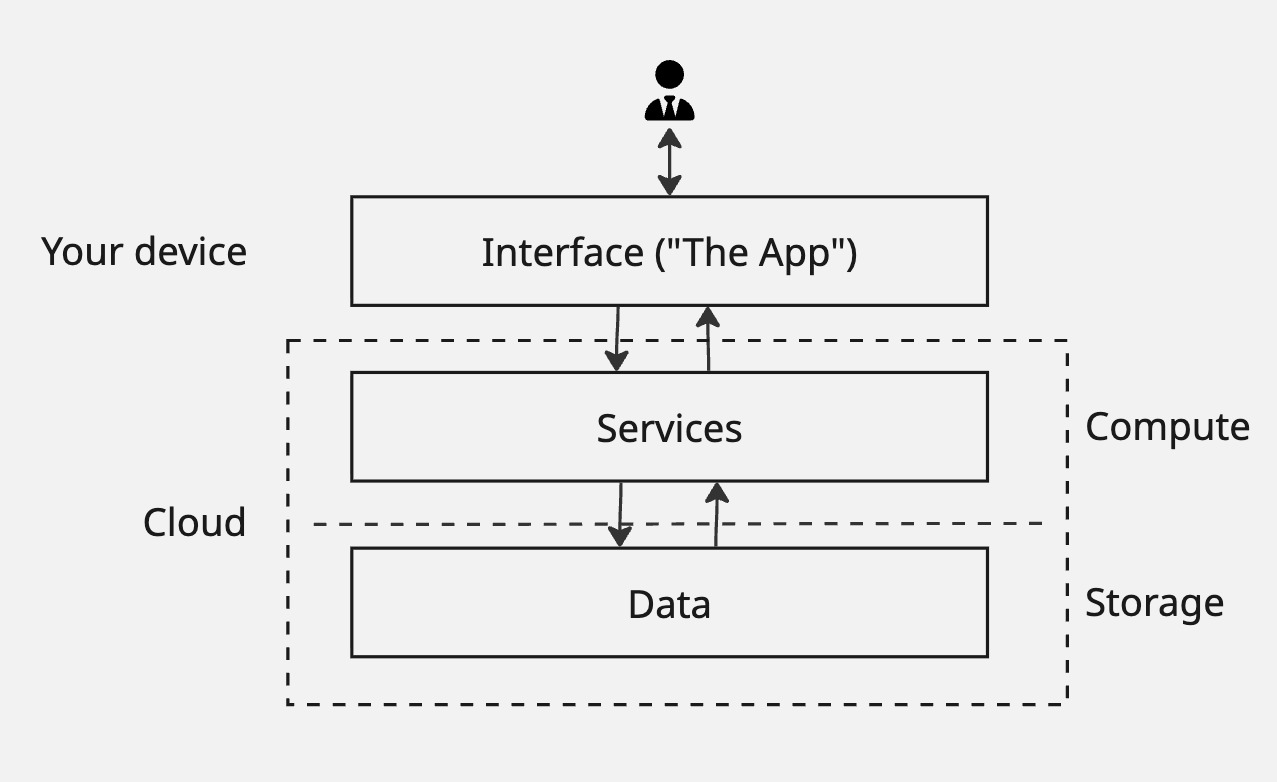
<p>Let me break down what software really is. Every software solution has three layers: an interface, services, and data. You load a page and click on a button (the interface), that sends a message with your intent to the cloud (services), and that stores or retrieves information from a database (data).</p>

<p><img src="/assets/images/softwarelayers.jpg" alt="Software Layers" /></p>

<p>(You may be familiar with the terms ‘compute’ and ‘storage’ - services run on compute resources, data lives in storage resources.)</p>

<p>Here’s a simple example: I go to an ecommerce site powered by Shopify. I enter a search term in the interface, which my browser sends to Shopify’s cloud services, which scans their product catalog for matches. The matches are sent back to the interface via the service, and the interface shows me those matching products on a screen (a list of names, prices, pictures, etc.)</p>

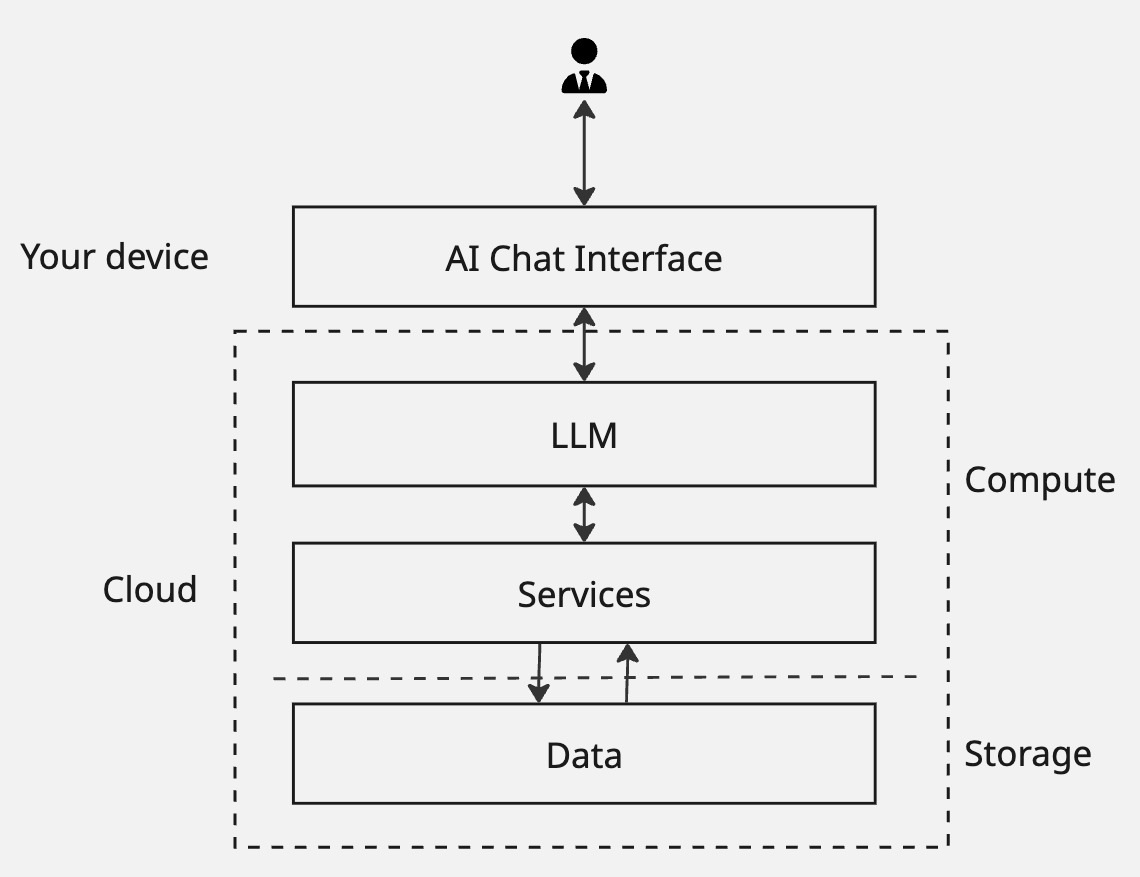
<p>Now let’s look at how OpenClaw plays into this. Instead of entering the search term in the ecommerce site, I enter it into Telegram or a text message. An LLM translates and sends my request to Shopify’s cloud services, which then scans their product catalog and sends the matches back to the LLM, which then sends me a human readable message back in the chatbox.</p>

<p><img src="/assets/images/softwarelayers2.jpg" alt="Software Layers with LLM" /></p>

<p>OpenClaw didn’t bypass Shopify, it used Shopify. Yes, it didn’t rely on Shopify’s web interface but it did rely on the services and data layer of Shopify. That’s what “software” really is and it’s where the real value lies in these companies. The interface is just how it is delivered to you. OpenClaw - and more generally, all agentic AI - is simply an alternative interface for accessing the real value of these software companies.</p>

<p>Running down the list of skills on clawhub.ai, a repository for OpenClaw skills you can enable, they’re all interface alternatives. Manage your gmail and calendar from OpenClaw, summarize a YouTube video, get the weather, read and respond to your Slack messages, review Yahoo Finance data on a company, create a new invoice in your accounting platform.</p>

<p>The common theme here is not that software is being replaced, another layer of software has been introduced. This is actually re-intermediation.</p>

<p>OpenClaw is quite literally Uber Eats for clicking your mouse.</p>

<p>And the interfaces we’re used to today - screens full of information, clicking on buttons, entering text - these aren’t going away. A table of information - with color coded highlights, varying text sizes, and tools to sort and filter - is VASTLY more information-dense than natural language. Natural language interfaces will augment what we have today, not replace it. (In fact, if you’re using CLI tools like Claude Code or Codex, you’re already doing this.)</p>

<p>Anyway, this is all very reminiscent of crypto and web3, because they run the same playbook (and by “they”, I mean the same investors). web3’s promise was to move storage and compute from these “greedy and censored” cloud providers into a distributed network of personal computers. Crypto’s promise was to move value exchanges from these “greedy and oppressive” governments and banks into a distributed network of personal computers.</p>

<p>But in reality, the cloud providers, banks and governments actually serve really useful functions that took decades to evolve and are a lot more complex than many realize. When you care about your business being reliable and secure, you don’t really want your core services running on a daisy-chain of Windows 95 laptops in the basement of a brothel in Cambodia.</p>

<p>So what is really going to happen? Here’s a few things to bet on:</p>

<h4 id="1-existing-useful-software-will-actually-grow-their-user-base-and-be-even-stickier">1. Existing, useful software will actually grow their user base and be even stickier</h4>

<p>Think about something like Quickbooks. If you meet someone that just started a small business, they’ll say something like “why isn’t there a simpler Quickbooks, this is overwhelming” and that’s because Quickbooks solves a lot of problems that they just don’t have this early in the game.</p>

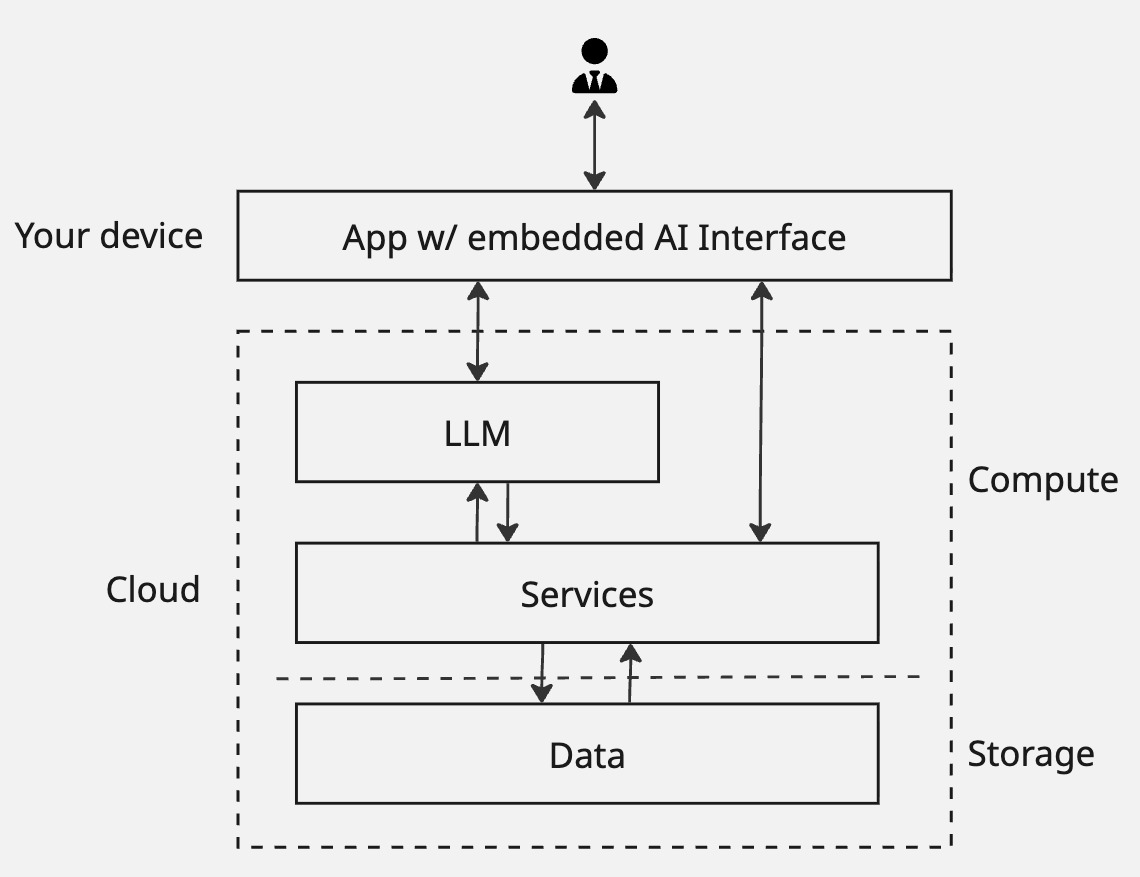
<p>But it’s not like you can build a “simpler accounting system”, because accounting is what it is - but Quickbooks can integrate an agent into the stack, providing a gentler, alternative interface based on natural language to get them started. They don’t have to be a power user of a complex interface, they can just say things like “can you create an invoice for me”.</p>

<p><img src="/assets/images/softwarelayers3.jpg" alt="Software Layers with LLM+App" /></p>

<p>Intuit picks up a customer earlier than they normally would. The customer sticks with the product when they would otherwise get overwhelmed and stop using it, because they don’t get stuck when an agent is helping them 24/7. The important point here is that Intuit doesn’t have to create a new product for small businesses, they simply create a new interface that plugs into the backbone (services and data) of their existing solution. This is a drastically lighter lift and enables a frictionless transition to their “pro” interface.</p>

<p>And yes, there will be general purpose AI agents that can orchestrate multiple tools, just like Zapier does today. But those agents will be the big players: Gemini, Claude, ChatGPT, etc. They already can do some of this now, but there are serious concerns around limiting their ability to not do crazy things (like re-invest your 401k in a shitcoin).</p>

<h4 id="2-companies-who-make-their-money-on-the-interface-alone-are-in-for-a-hard-time">2. Companies who make their money on the interface alone are in for a hard time</h4>

<p>Advertising-funded media companies will be hit especially hard. If you’re a news outlet, you don’t make your money on providing anything of substance, you make money on selling attention to advertisers. They don’t have a services and data moat, the interface (e.g. their website or the cable news program) needs to be viewed directly in order to show the consumer ads. They’ll face the same fate as Wikipedia and StackOverflow.</p>

<p>If you’re a social media company, the cost to post garbage approaches zero. All of those influencers being paid to post straight up propaganda are no longer necessary - they are paid actors, and bots can do it cheaper and better. It’s not like anyone is verifying the authenticity of these posters in the first place. The channels will be flooded with slop such that eventually everyone becomes disinterested. We’re already seeing this play out.</p>

<h4 id="3-scriptable-jobs-get-eviscerated">3. Scriptable jobs get eviscerated</h4>

<p>AI isn’t the death of white collar work, but is the death of work that follows a process. Tier 1 Help Desk support, manual QA testing, call centers, entry-level SDRs, data entry and order processing, insurance claims intake, content moderation, are all at risk. AI can do it better, and let’s be honest, many people don’t treat these workers as human to begin with.</p>

<h3 id="final-thoughts">Final Thoughts</h3>
<p>The one outstanding question that remains is… who pays for this? Right now, tokens are highly subsidized to hook users. That’ll end once a certain point of adoption is reached (again, Uber Eats is the appropriate analog here).</p>

<p>Does Quickbooks charge MORE for a user that uses the agent interface, because it costs them more? Do they sprinkle that cost across their entire user base?</p>

<p>If a company was already paying 40k/yr for a Tier 1 Help Desk role, are they willing to pay 20k for an agent?</p>

<p>Either way, AI isn’t killing software, it’s injecting steroids into it.</p>]]></content><author><name></name></author><category term="models" /><summary type="html"><![CDATA[80% of apps aren’t going away. AI is not killing software. SaaS is not dying.]]></summary></entry><entry><title type="html">maybe ai ads are a good thing</title><link href="https://joeconway.io/2026/02/12/maybe-ai-ads-are-a-good-thing.html" rel="alternate" type="text/html" title="maybe ai ads are a good thing" /><published>2026-02-12T00:00:00+00:00</published><updated>2026-02-12T00:00:00+00:00</updated><id>https://joeconway.io/2026/02/12/maybe-ai-ads-are-a-good-thing</id><content type="html" xml:base="https://joeconway.io/2026/02/12/maybe-ai-ads-are-a-good-thing.html"><![CDATA[<p>To sell something today, you have to direct a buyer’s attention towards your product.</p>

<p>If someone has already identified their problem and is looking for a solution, a business might get their attention with SEO, ad targeting, trade shows and the like.</p>

<p>For other types of sales, getting attention means putting on a show and positioning your brand in the viewer’s line of sight. If I want to sell Doritos, I buy a billboard at the Super Bowl. If I want to sell makeup, I have Kim K name drop it during a drama-fueled episode of The Kardashians. If I want you to watch my movie, I print salacious stories about the movie star in the tabloids. If I want you to vote for me or donate to my campaign, I pay social media influencers to drum up a controversy that only I can solve for you.</p>

<p>The attention getter is not the product: it’s the entertainment, the controversy, or maybe just a beautiful person. This is very noisy - only a small fraction of billboard viewers are in the target audience, and even fewer convert to a sale.</p>

<p>It also, and more impactfully, creates all sorts of side effects that are detrimental to society. The beautiful, photoshopped model creates insecurity and unrealistic expectations around relationships. The manufactured controversy isolates people from their community and guides them towards self-defeating decisions. The salacious stories keep people’s faces glued to their devices instead of living in the real world.</p>

<p>It’s possible AI ads would change that dynamic by removing the need for that anti-social noise. I solve a lot of problems with Gemini - things like “why is my baby so fussy” and “what gauge of wire do I need to connect this battery to my circuit”. Gemini could simply suggest what, if anything, that I need to buy. This collapses the process that goes from attention to purchase because my problem is very clearly defined - even if I didn’t really know what the problem was in the first place.</p>

<p>Admittedly, this idea is hard for me to fully wrap my head around - because are Doritos really a solution to anything? How much of what is being sold isn’t a solution, but rather taking advantage of people’s impulses and insecurities. Maybe nothing will change and this will become another noise-filled channel.</p>]]></content><author><name></name></author><summary type="html"><![CDATA[To sell something today, you have to direct a buyer’s attention towards your product.]]></summary></entry><entry><title type="html">technology isn’t invented, it’s inevitable</title><link href="https://joeconway.io/2025/06/03/technology-isnt-invented-its-inevitable.html" rel="alternate" type="text/html" title="technology isn’t invented, it’s inevitable" /><published>2025-06-03T00:00:00+00:00</published><updated>2025-06-03T00:00:00+00:00</updated><id>https://joeconway.io/2025/06/03/technology-isnt-invented-its-inevitable</id><content type="html" xml:base="https://joeconway.io/2025/06/03/technology-isnt-invented-its-inevitable.html"><![CDATA[<p>I was training an engineering team at Apple in 2010 after a minor, but important, technology advancement - and they were pissed.</p>

<p>I won’t bore you with the technical details, but real quick, the advancement was called ARC and before it you frequently wrote code that was basically an arcane set of rituals. If you got them wrong, your application would simply crash. Hours - sometimes days - would be spent resolving easy-to-make mistakes. It was also a major obstacle to learning the platform for new developers.</p>

<p>ARC did away with all of this - the computer could now do the rituals without any input from the engineer.</p>

<p>So, why were they upset? They said ARC could only handle really basic situations. It would never understand the big, complex codebases they work on. It’ll get in the way of experienced engineers knowing what to do. It’ll introduce bugs and security issues that don’t get caught. It’ll prevent junior engineers from learning how to do things the right way.</p>

<p>None of these things happened; ARC was an overwhelming success. Overnight, an entire workload and class of problems simply disappeared. Productivity boomed for anyone who already had experience, and the barrier to entry dropped for people who had a lot to offer but didn’t/couldn’t understand the arcane rituals.</p>

<p>This resistance to ARC sounds familiar to the AI pessimism of today. And that’s because it is: humans have been repeating the same pattern since forever. The issue isn’t about the technology, it’s a personal fear of one’s economic moat disappearing. I’m quite certain the guy carrying water back to the village threw a little tantrum about the invention of the wheel, too.</p>

<p>It probably feels good to thumbs-up a “back in my day” post. But that’s not a strategy to rebuild a moat - especially when it takes the same number of keystrokes to build a new feature as it does to write a head-in-the-sand hot take on LinkedIn.</p>

<p>Here’s the thing about technology - it’s not invented, it’s inevitable. Hoping for regulation to slow it? That just gives an advantage to those who don’t follow the rules and have the resources to afford the consequences of breaking them. The iPhone would have been invented without Steve Jobs, AI would have existed in its current form without Sam Altman. There’s a reason Sci-Fi often seems to predict the future - this stuff is destined. You can either ride the wave or have it smash into you.</p>]]></content><author><name></name></author><category term="tech" /><summary type="html"><![CDATA[I was training an engineering team at Apple in 2010 after a minor, but important, technology advancement - and they were pissed.]]></summary></entry><entry><title type="html">all kpis are derivatives of revenue or cost</title><link href="https://joeconway.io/2025/01/15/all-kpis-are-derivatives-of-revenue-or-costs.html" rel="alternate" type="text/html" title="all kpis are derivatives of revenue or cost" /><published>2025-01-15T00:00:00+00:00</published><updated>2025-01-15T00:00:00+00:00</updated><id>https://joeconway.io/2025/01/15/all-kpis-are-derivatives-of-revenue-or-costs-</id><content type="html" xml:base="https://joeconway.io/2025/01/15/all-kpis-are-derivatives-of-revenue-or-costs.html"><![CDATA[<p>Every metric, objective or goal should be driving revenue or reducing cost. If it isn’t, it’s not something a business, product or team should be pursuing.</p>

<p>I often see this concept interpreted incorrectly. Especially when it comes to areas like employee happiness, satisfaction and wellness - metrics like net promoter score (NPS), employee satisfaction, feedback frequency, etc. I’ll call these “culture metrics”.</p>

<p>There’s two ways that people often miss the mark here.</p>

<p>The obvious one is the leader that doesn’t value their employees. “Employee wellbeing is not important - only the bottom line.” This is the stereotypical bad boss we’ve all seen on TV and maybe even in our own workplace. Their belief that company performance is more important than the people that make up the company has a negative impact on both revenue and cost.</p>

<p>The math here is simple: it costs money to hire someone and losing an employee is <em>really expensive</em>. There’s a hard cost of a recruiter fee or having an internal recruiting team. There’s the opportunity cost that your existing staff is spending on interviewing candidates. There’s the onboarding cost that can take weeks of low or no productivity. Culture metrics may seem woo-woo, but they are leading indicators to real, financially impactful metrics like turnover and retention. Not to mention, a high NPS leads to employee referrals that substantially reduce the cost of hiring - aka growth.</p>

<p>The less obvious one is the leader that finds it morally distasteful to roll up culture metrics into financial metrics. They might look at the headline of this essay and say “profits aren’t the only thing that matter, people matter too!” But that perspective is equally as toxic as dismissing culture metrics altogether. Investment in a person’s wellbeing isn’t devalued because it aligns with a company’s mission. In fact, that alignment is necessary for the wellbeing of the employee: you can’t pay salaries or health insurance premiums without it.</p>

<p>An amazing company culture can only exist if the company exists, and that requires making more money than you spend. And in order to bring that culture to more people, the delta between revenue and expenses (aka profit) has to afford it. It’s critically important that every measurement rolls up into revenue or cost, but it’s also critically important that revenue and cost aren’t the only measurements.</p>]]></content><author><name></name></author><category term="leadership" /><summary type="html"><![CDATA[Every metric, objective or goal should be driving revenue or reducing cost. If it isn’t, it’s not something a business, product or team should be pursuing.]]></summary></entry><entry><title type="html">how to build good feedback cycles</title><link href="https://joeconway.io/2024/12/06/how-to-create-feedback-cycles.html" rel="alternate" type="text/html" title="how to build good feedback cycles" /><published>2024-12-06T00:00:00+00:00</published><updated>2024-12-06T00:00:00+00:00</updated><id>https://joeconway.io/2024/12/06/how-to-create-feedback-cycles</id><content type="html" xml:base="https://joeconway.io/2024/12/06/how-to-create-feedback-cycles.html"><![CDATA[<p>I shared my thoughts on <a href="/2024/10/30/make-better-feedback-cycles.html">how important feedback cycles</a> are with a friend, and since they are <a href="https://ialign.app/">building something right now</a>, they asked if I had advice on <em>how</em> to create feedback cycles.</p>

<p>Now, every feedback cycle is different - the feedback cycle you need to get better at boxing is different than the one you need to build a successful software product. But, the structure is generally the same: identify what needs improvement, make a change, try it out; repeat.</p>

<p>What needs to be improved, what change to make, and what it means to “try it out” are all areas where you need good inputs. Your own instincts are useful, especially for interpreting those inputs, but what you really need is other people giving their perspective on all three. If you’re building software, you need people to use that software. If you’re training to be a boxer, you need opponents to fight. Customers and opponents seem like very different things, but in the context of feedback, they play the same role: they test what truly matters.</p>

<p>And that’s what differentiates a good feedback cycle from a bad one: does it really address what matters? There is no silver bullet for determining that, because again, every feedback cycle is different, but here are some helpful things I’ve learned about feedback cycles over the years:</p>

<ol>
  <li>Avoid the “mom test”. If you ask your mom about your new business venture, she is going to tell you it’s great. This is the same person that hung your crappy crayon drawings on the refrigerator with pride. She - and your friends, family, and most people in your life - will want to support you, but that is very different than feedback. You’ll need both feedback and support, but don’t mistake one for the other.</li>
  <li>The only people’s feedback that matter are the people that have a self-interest in what you are doing. If someone is using your software to do their taxes, they need it to be right so they don’t go to jail. Contrast that with, say, an accountant friend of yours that has no need for your software - they might seem like a good person to get feedback from because they know the industry, but they are not a user or a prospect and their feedback isn’t as important.</li>
  <li>Demonstrate <em>extreme openness</em> - not only when receiving feedback, but any interaction you have with someone that you want feedback from. It’s not enough that to detach your ego from what you are doing, but the feedback giver has to <em>know</em> that you have. If they feel like they are going to hurt your feelings or get a defensive response from you, you won’t get good feedback.</li>
  <li>In the beginning, focus on more intimate feedback from a smaller group of people. In the future, you will need to cast a wider net with automated feedback (e.g. a “report an issue” button), having an impersonal form or email address, or having a team to manage it (e.g. customer support). But, in the beginning, you want to build direct relationships that you can cultivate, because…</li>
  <li>You need lots of reps in the beginning. The tighter the feedback cycle in the beginning, the more reps you can get in, and the more likely you are to get liftoff. Find ways to reduce the cost of gathering and implementing feedback. This is why a smaller, intimate group is valuable - the more trust you have with someone, the easier it is to transfer information. It’s the same reason having industry experience is so helpful - you can speak the same language as the people giving feedback.</li>
  <li>Let people know they made an impact with their feedback. Not only will this make them more likely to provide feedback in the future, they’re going to be proud of their contribution and want to share what you are creating with others. And referrals are always the best lead gen source!</li>
</ol>]]></content><author><name></name></author><category term="tech" /><summary type="html"><![CDATA[I shared my thoughts on how important feedback cycles are with a friend, and since they are building something right now, they asked if I had advice on how to create feedback cycles.]]></summary></entry><entry><title type="html">my one recommendation to be successful at anything</title><link href="https://joeconway.io/2024/11/13/my-one-recommendation-to-be-successful-at-anything.html" rel="alternate" type="text/html" title="my one recommendation to be successful at anything" /><published>2024-11-13T00:00:00+00:00</published><updated>2024-11-13T00:00:00+00:00</updated><id>https://joeconway.io/2024/11/13/my-one-recommendation-to-be-successful-at-anything</id><content type="html" xml:base="https://joeconway.io/2024/11/13/my-one-recommendation-to-be-successful-at-anything.html"><![CDATA[<p>If you’d like to be successful, I have one recommendation: spend a month consuming media you disagree with. If you’re watching MSNBC, watch Fox News. If you’re active on social media, change your algorithm by creating a new account and follow accounts you disagree with. If you’re listening to Joe Rogan, try Jon Stewart. If you’re scrolling Reddit, subscribe to /r/Conservative.</p>

<p>The goal of this isn’t to change your mind about what you believe, nor is it about finding a more balanced or nuanced view. Instead, when you watch or listen to media that is in conflict with what you believe, you will naturally pick it apart. Over time, you will recognize the patterns used to influence other people’s beliefs and decisions.</p>

<p>When you return to the media you are used to, you will see those same patterns. You’ll realize that many of your beliefs have been shaped by advertisers, political parties, governments, religions, social groups and anyone else that can produce media (which today, is anyone with a smartphone!) You may even recognize that the lessons your parents taught you came from the media they consumed.</p>

<p>Now, most people won’t do this. It is a difficult process that will strip your identity down to almost nothing. It’s a lot easier to stay within the comfort of an existing identity. For many, it is too humiliating to admit that they’ve been duped. For some, it is simply too depressing to confront the idea that their heroes are just good marketers.</p>

<p>But if you choose to go down this road, you’ll discover true freedom. You’ll see little value in the media that the average American spends 11 hours a day consuming. That’s over 4,000 hours a year - the equivalent of two full-time jobs - time that could now be yours.</p>

<p>With this newfound clarity and time, you can focus on what truly matters. You’ll be able to define success on your own terms and pursue goals that genuinely impact your life. While others remain distracted and influenced by the noise, you’ll have a significant advantage. You’ll have three times more time and energy each day to work toward your vision, think critically, and excel in ways most people never will.</p>]]></content><author><name></name></author><category term="focus" /><summary type="html"><![CDATA[If you’d like to be successful, I have one recommendation: spend a month consuming media you disagree with. If you’re watching MSNBC, watch Fox News. If you’re active on social media, change your algorithm by creating a new account and follow accounts you disagree with. If you’re listening to Joe Rogan, try Jon Stewart. If you’re scrolling Reddit, subscribe to /r/Conservative.]]></summary></entry><entry><title type="html">generative ai is an opportunity for every business</title><link href="https://joeconway.io/2024/11/02/generative-ai-is-a-feature-opportunity.html" rel="alternate" type="text/html" title="generative ai is an opportunity for every business" /><published>2024-11-02T00:00:00+00:00</published><updated>2024-11-02T00:00:00+00:00</updated><id>https://joeconway.io/2024/11/02/generative-ai-is-a-feature-opportunity</id><content type="html" xml:base="https://joeconway.io/2024/11/02/generative-ai-is-a-feature-opportunity.html"><![CDATA[<p>Generative AI is hot right now. It’s a lot like the early days of mobile where every company had to have an app - even if it was useless. Eventually, businesses figured out how to leverage mobile and offered compelling solutions that millions of people use daily.</p>

<p>Right now, every product is getting a chatbot and that isn’t particularly innovative. But that’s okay, early mobile apps were mostly flashlights, websites-in-an-app, and gimmicks like magic 8-balls. Innovation often begins this way: by building the same solutions with new technology. The real breakthroughs happen when we shift focus to solving existing problems in new ways that weren’t previously available.</p>

<p>Mobile and generative AI have one thing in common that makes them platforms for innovation: they revolutionize the way humans interact with machines. Take the iPhone, for example - it made the internet accessible almost everywhere, almost all the time. The possibilities for solving problems when the internet is always in your pocket? Virtually endless.</p>

<p>Generative AI offers a similar leap forward, and there are two major opportunities every business leader should understand:</p>

<ol>
  <li>
    <p>Interacting with our devices is surprisingly rudimentary. We communicate with our phones the same way we might with chimpanzees or toddlers - by pointing at pictures and tapping. But now, machines can understand and produce language, images, videos, and sounds. This makes communication far more natural and intuitive for humans, eliminating significant barriers between human and machine.</p>
  </li>
  <li>
    <p>We have access to an unimaginable amount of information. But there’s a problem: much of it is low-quality, overly commercialized, or simply too vast to navigate efficiently. Generative AI compresses massive amounts of information and makes searching it faster and more effective.</p>
  </li>
</ol>

<p>The next wave of economic winners will be those who effectively apply these two ideas in meaningful ways to their businesses and products.</p>]]></content><author><name></name></author><category term="tech" /><summary type="html"><![CDATA[Generative AI is hot right now. It’s a lot like the early days of mobile where every company had to have an app - even if it was useless. Eventually, businesses figured out how to leverage mobile and offered compelling solutions that millions of people use daily.]]></summary></entry><entry><title type="html">make better feedback cycles</title><link href="https://joeconway.io/2024/10/30/make-better-feedback-cycles.html" rel="alternate" type="text/html" title="make better feedback cycles" /><published>2024-10-30T00:00:00+00:00</published><updated>2024-10-30T00:00:00+00:00</updated><id>https://joeconway.io/2024/10/30/make-better-feedback-cycles</id><content type="html" xml:base="https://joeconway.io/2024/10/30/make-better-feedback-cycles.html"><![CDATA[<p>When I was writing a book, I was also teaching a course based on the book. I built this little app that helped me organize, navigate and edit the book’s content quickly. When something didn’t make sense to a student, I could make changes to the book in realtime. A lot of the success of that book came from the speed of that feedback cycle.</p>

<p>I realized that this idea of making better feedback cycles was an effective tool for most things in life. It was the same thing when I ran a company. We would build new software products for clients and the successful ones all had one thing in common: they established feedback cycles with customers as early as possible.</p>

<p>My approach is to get at least a few users using <em>something</em> in their environment. It doesn’t have to be anything close to the final product, but it needs to offer enough value that they <em>actually</em> use it. If they aren’t using it, then you aren’t meaningfully solving a problem of theirs. If they say, “Yeah, but I wish it did this…”, then you’ve started the feedback cycle.</p>]]></content><author><name></name></author><category term="tools" /><summary type="html"><![CDATA[When I was writing a book, I was also teaching a course based on the book. I built this little app that helped me organize, navigate and edit the book’s content quickly. When something didn’t make sense to a student, I could make changes to the book in realtime. A lot of the success of that book came from the speed of that feedback cycle.]]></summary></entry><entry><title type="html">rubber duck debugging</title><link href="https://joeconway.io/2024/10/22/rubber-duck-debugging.html" rel="alternate" type="text/html" title="rubber duck debugging" /><published>2024-10-22T00:00:00+00:00</published><updated>2024-10-22T00:00:00+00:00</updated><id>https://joeconway.io/2024/10/22/rubber-duck-debugging</id><content type="html" xml:base="https://joeconway.io/2024/10/22/rubber-duck-debugging.html"><![CDATA[<p>In software, we do something called ‘rubber duck debugging’. It’s where you tell a little rubber duck about the problem you are trying to solve, and you end up solving it yourself while you’re explaining it.</p>

<p>It’s because to solve a problem, you need to define it. Saying it out loud forces you to organize the problem enough to communicate it - giving it proper definition. The solution becomes obvious.</p>

<p>You don’t really need a rubber duck, and it works for every type of problem - not just engineering. If you’re trying to do something and keep getting stuck, say what you’re doing out loud or write it in email to someone (even if you don’t send it).</p>]]></content><author><name></name></author><category term="tools" /><summary type="html"><![CDATA[In software, we do something called ‘rubber duck debugging’. It’s where you tell a little rubber duck about the problem you are trying to solve, and you end up solving it yourself while you’re explaining it.]]></summary></entry></feed>