

openclaw is uber eats for clicking your mouse
80% of apps aren’t going away. AI is not killing software. SaaS is not dying.
The current prevailing thought (for this month at least) is that AI is going to replace software. Why would you pay $50k/yr for Salesforce when you can just enable an OpenClaw skill and have it manage your contacts and outreach for you?
It sounds too good to be true because it isn’t true. OpenClaw is more of a marketing campaign than a product. It’s a good demonstration of some things you can already do with AI and software, and it brings the concept of orchestration to a broader audience.
The hype around it is paid advertising. The tweets, articles, podcasts and Reddit comments are advertisements to promote token spend. (Given that major investors in OpenAI are also investors in https://doublespeed.ai/, a tool to astroturf the internet with authentic-sounding comments from bots, you can assume many of the comments are not genuine.)
Now, I’m a big AI user. I pay for Gemini Ultra. I spend hundreds a month on Claude Code. I’m all in on AI - it boosts my productivity by a solid 10-20%, and it also helps me accomplish some things I wouldn’t otherwise get started on because of the time it would take without AI. But the idea that Microsoft, Google, Shopify, ServiceNow, Atlassian, Monday.com, etc. are going to be disintermediated by AI is a misunderstanding of software.
Let me break down what software really is. Every software solution has three layers: an interface, services, and data. You load a page and click on a button (the interface), that sends a message with your intent to the cloud (services), and that stores or retrieves information from a database (data).
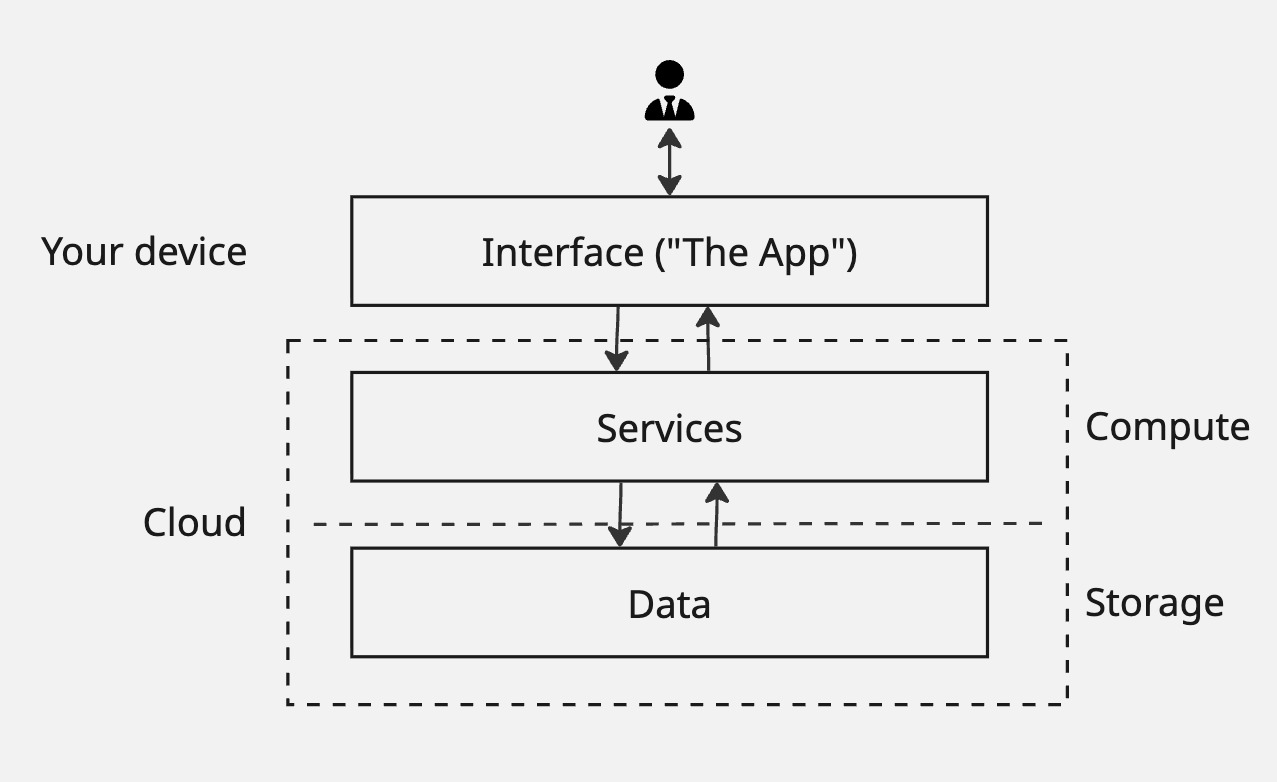
(You may be familiar with the terms ‘compute’ and ‘storage’ - services run on compute resources, data lives in storage resources.)
Here’s a simple example: I go to an ecommerce site powered by Shopify. I enter a search term in the interface, which my browser sends to Shopify’s cloud services, which scans their product catalog for matches. The matches are sent back to the interface via the service, and the interface shows me those matching products on a screen (a list of names, prices, pictures, etc.)
Now let’s look at how OpenClaw plays into this. Instead of entering the search term in the ecommerce site, I enter it into Telegram or a text message. An LLM translates and sends my request to Shopify’s cloud services, which then scans their product catalog and sends the matches back to the LLM, which then sends me a human readable message back in the chatbox.
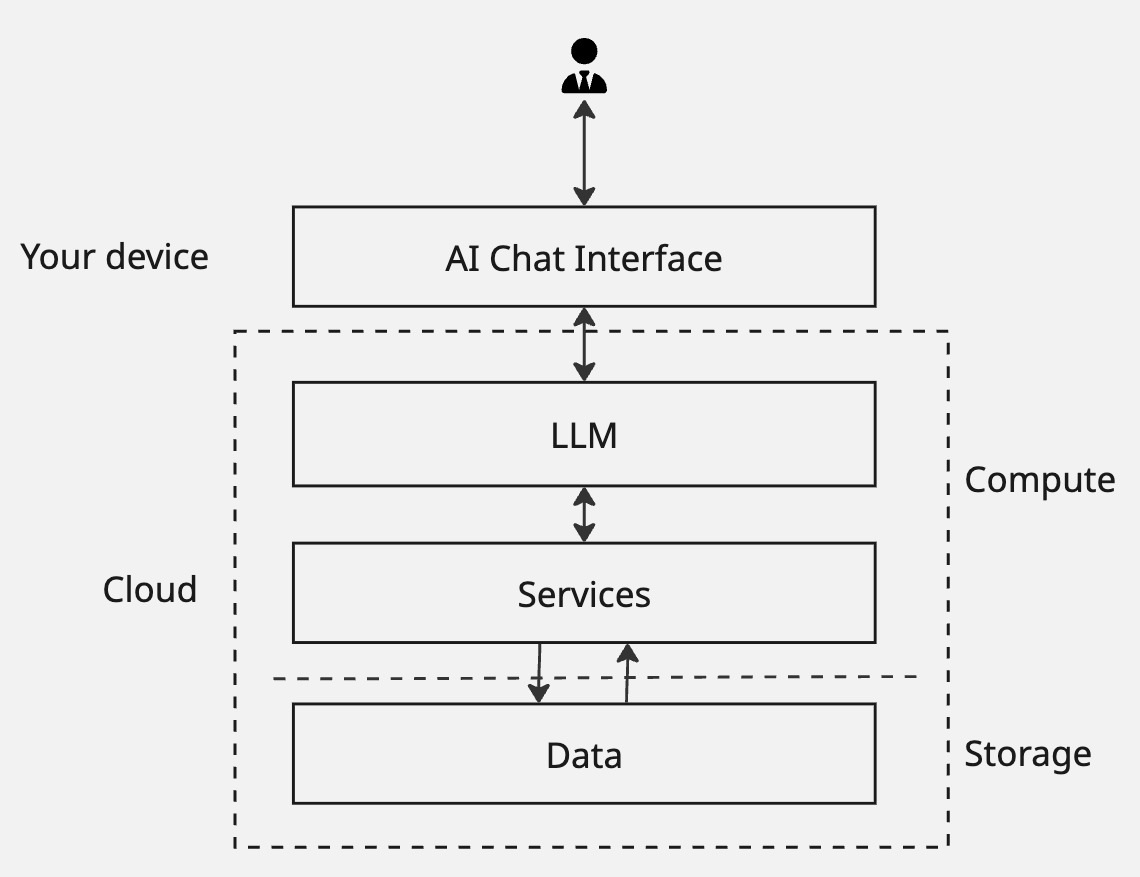
OpenClaw didn’t bypass Shopify, it used Shopify. Yes, it didn’t rely on Shopify’s web interface but it did rely on the services and data layer of Shopify. That’s what “software” really is and it’s where the real value lies in these companies. The interface is just how it is delivered to you. OpenClaw - and more generally, all agentic AI - is simply an alternative interface for accessing the real value of these software companies.
Running down the list of skills on clawhub.ai, a repository for OpenClaw skills you can enable, they’re all interface alternatives. Manage your gmail and calendar from OpenClaw, summarize a YouTube video, get the weather, read and respond to your Slack messages, review Yahoo Finance data on a company, create a new invoice in your accounting platform.
The common theme here is not that software is being replaced, another layer of software has been introduced. This is actually re-intermediation.
OpenClaw is quite literally Uber Eats for clicking your mouse.
And the interfaces we’re used to today - screens full of information, clicking on buttons, entering text - these aren’t going away. A table of information - with color coded highlights, varying text sizes, and tools to sort and filter - is VASTLY more information-dense than natural language. Natural language interfaces will augment what we have today, not replace it. (In fact, if you’re using CLI tools like Claude Code or Codex, you’re already doing this.)
Anyway, this is all very reminiscent of crypto and web3, because they run the same playbook (and by “they”, I mean the same investors). web3’s promise was to move storage and compute from these “greedy and censored” cloud providers into a distributed network of personal computers. Crypto’s promise was to move value exchanges from these “greedy and oppressive” governments and banks into a distributed network of personal computers.
But in reality, the cloud providers, banks and governments actually serve really useful functions that took decades to evolve and are a lot more complex than many realize. When you care about your business being reliable and secure, you don’t really want your core services running on a daisy-chain of Windows 95 laptops in the basement of a brothel in Cambodia.
So what is really going to happen? Here’s a few things to bet on:
1. Existing, useful software will actually grow their user base and be even stickier
Think about something like Quickbooks. If you meet someone that just started a small business, they’ll say something like “why isn’t there a simpler Quickbooks, this is overwhelming” and that’s because Quickbooks solves a lot of problems that they just don’t have this early in the game.
But it’s not like you can build a “simpler accounting system”, because accounting is what it is - but Quickbooks can integrate an agent into the stack, providing a gentler, alternative interface based on natural language to get them started. They don’t have to be a power user of a complex interface, they can just say things like “can you create an invoice for me”.
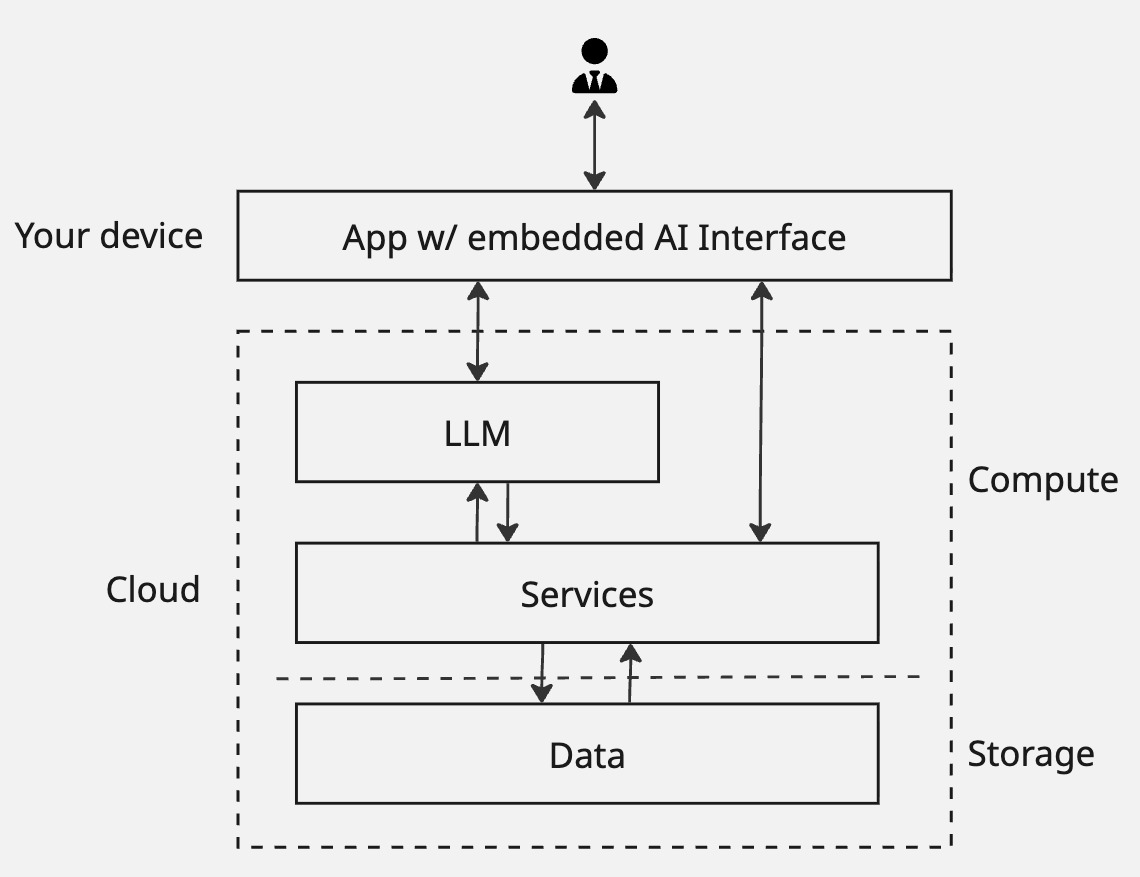
Intuit picks up a customer earlier than they normally would. The customer sticks with the product when they would otherwise get overwhelmed and stop using it, because they don’t get stuck when an agent is helping them 24/7. The important point here is that Intuit doesn’t have to create a new product for small businesses, they simply create a new interface that plugs into the backbone (services and data) of their existing solution. This is a drastically lighter lift and enables a frictionless transition to their “pro” interface.
And yes, there will be general purpose AI agents that can orchestrate multiple tools, just like Zapier does today. But those agents will be the big players: Gemini, Claude, ChatGPT, etc. They already can do some of this now, but there are serious concerns around limiting their ability to not do crazy things (like re-invest your 401k in a shitcoin).
2. Companies who make their money on the interface alone are in for a hard time
Advertising-funded media companies will be hit especially hard. If you’re a news outlet, you don’t make your money on providing anything of substance, you make money on selling attention to advertisers. They don’t have a services and data moat, the interface (e.g. their website or the cable news program) needs to be viewed directly in order to show the consumer ads. They’ll face the same fate as Wikipedia and StackOverflow.
If you’re a social media company, the cost to post garbage approaches zero. All of those influencers being paid to post straight up propaganda are no longer necessary - they are paid actors, and bots can do it cheaper and better. It’s not like anyone is verifying the authenticity of these posters in the first place. The channels will be flooded with slop such that eventually everyone becomes disinterested. We’re already seeing this play out.
3. Scriptable jobs get eviscerated
AI isn’t the death of white collar work, but is the death of work that follows a process. Tier 1 Help Desk support, manual QA testing, call centers, entry-level SDRs, data entry and order processing, insurance claims intake, content moderation, are all at risk. AI can do it better, and let’s be honest, many people don’t treat these workers as human to begin with.
Final Thoughts
The one outstanding question that remains is… who pays for this? Right now, tokens are highly subsidized to hook users. That’ll end once a certain point of adoption is reached (again, Uber Eats is the appropriate analog here).
Does Quickbooks charge MORE for a user that uses the agent interface, because it costs them more? Do they sprinkle that cost across their entire user base?
If a company was already paying 40k/yr for a Tier 1 Help Desk role, are they willing to pay 20k for an agent?
Either way, AI isn’t killing software, it’s injecting steroids into it.